

Nova Scotia
Among The Last Clam Diggers
The tidal flats at Clam Harbour hold a history of clam digging that stretches back thousands of years
By Izabela Jaroszynski
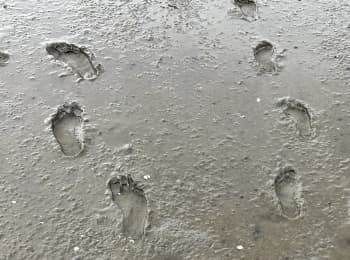
We go out in our bare feet, toes quickly sinking deep into the squishy mud.
“Some people pay big money for this kind of spa treatment,” quips Darcy Baker, our clam-digging guide, as our small group moves slowly through the mudflats along the shore and out to the firmer sand flats beyond.
In a few hours, the rising tide will wash away any trace of our footprints, just as it has done for the many generations of clam diggers who came before us.
There is archaeological evidence that humans have been harvesting clams here for thousands of years. The Mi'kmaw name for this stretch of land on Nova Scotia's Eastern Shore is E'se'katik, which roughly translates to 'the place of the clams'. Settlers didn't veer too far from that name, calling it Clam Harbour for the rich intertidal mud and the sand flats that create a perfect habitat for soft-shell clams.
Darcy, a fourth-generation clam digger, has spent his whole life along the shores of Clam Harbour. He knows these flats well. He knows where to dig, how the tides move through and when an area has been harvested enough and needs to be left alone.
Today, he is showing us how to find our lunch.
"You have to put the rake in at an angle," Darcy says when we reach the dig area, demonstrating with his own rake. "They could be up to a foot deep."
Within seconds, Darcy has dug up half a dozen clams and tossed them into a pile on the wet sand.
Darcy first remembers digging for clams as a child alongside his grandfather, his grandmother and his dad.
"I fell in love with the ocean," he says. When Darcy is on the flats digging commercially, he can harvest around 200 pounds of clams during a tide. He has about four and a half hours before the water returns.
His practiced hand can now tell by feel if a clam is large enough to keep. The rest of us use the measuring tool attached to our rakes.
If a clam is small enough to pass through the opening, it is too small to harvest and goes back into the sand. Clams can live up to 25 years in these waters, Darcy says, and take nearly a decade to reach a size that is acceptable for harvest.
Clamming with Darcy is part of the Memory Lane Heritage Village Clam Digging Experience. We began at the village where we received a short history lesson on the area and then drove about 10 minutes out to the sand flats where we are currently digging for clams.
It doesn't take more than a few minutes for most of us to realize that uprooting the clams from their cozy hiding spots in the wet sand isn't as easy as Darcy makes it look.
Photo: Paul Futhey
Photo: Paul Futhey
That's part of the reason he loves giving these hands-on demonstrations.
"It teaches you how precious the resource is, and what hard work it is," he tells me.
"People will say that clams are expensive, but once they dig them themselves, they never complain about the price again, right? It's hard work."
He likes to bring people out to the flats to share the craft and pass along the knowledge.
"There's not a lot of us left," he says. "When it comes to clam diggers, I'm a young one and I'm 53. It's not a field young people are getting into, right?"
Clamming with Darcy is part of the Memory Lane Heritage Village Clam Digging Experience. We began at the village where we received a short history lesson on the area and then drove about 10 minutes out to the sand flats where we are currently digging for clams.
It doesn't take more than a few minutes for most of us to realize that uprooting the clams from their cozy hiding spots in the wet sand isn't as easy as Darcy makes it look.
Photo: Paul Futhey
Photo: Paul Futhey
That's part of the reason he loves giving these hands-on demonstrations.
"It teaches you how precious the resource is, and what hard work it is," he tells me.
"People will say that clams are expensive, but once they dig them themselves, they never complain about the price again, right? It's hard work."
He likes to bring people out to the flats to share the craft and pass along the knowledge.
"There's not a lot of us left," he says. "When it comes to clam diggers, I'm a young one and I'm 53. It's not a field young people are getting into, right?"
Back at the Memory Lane Heritage Village in Lake Charlotte, we tour the restored buildings while the kitchen staff prepare a traditional lumber camp meal of steamed clams, soup and sandwiches.
The village recreates life on Nova Scotia’s Eastern Shore in the 1940s, a period when electricity was beginning to reach rural communities and changing how people lived and worked.
Spread across the village are restored and reconstructed buildings that tell that story through the everyday: a general store, schoolhouse, church, cookhouse and family home, along with tools and equipment once used in the woods, on farms and along the shore.
It is a glimpse into a time when much of what a family ate, built or needed came from the land and water around them, including clams dug from the tidal flats.
Back at the Memory Lane Heritage Village in Lake Charlotte, we tour the restored buildings while the kitchen staff prepare a traditional lumber camp meal of steamed clams, soup and sandwiches.
The village recreates life on Nova Scotia’s Eastern Shore in the 1940s, a period when electricity was beginning to reach rural communities and changing how people lived and worked.
Spread across the village are restored and reconstructed buildings that tell that story through the everyday: a general store, schoolhouse, church, cookhouse and family home, along with tools and equipment once used in the woods, on farms and along the shore.
It is a glimpse into a time when much of what a family ate, built or needed came from the land and water around them, including clams dug from the tidal flats.
Photo: Paul Futhey
Photo: Paul Futhey
Photo: Paul Futhey
Photo: Paul Futhey
We eat our lunch in the cookhouse, at long wooden communal tables. The steamed clams, often called 'steamers', arrive in a large blue enamel bowl, with smaller bowls of malt vinegar and melted butter for dipping.
The server explains how to eat them: "First thing you have to know is that if they are closed, no go. Don't eat them," he says. "But if they are open, they are good to eat."
After cracking off the shell, he shows us how to peel the skin off the snouts — you can use your fingers or a fork — then dip it in your butter or vinegar and "down the hatch," he says.
The clams have been soaked to remove as much of the sand as possible, then steamed for a few minutes until they are soft and tender. Once you get the hang of pinching the dark skin on the neck siphon and removing it, the clams are surprisingly easy to eat.
I dip mine in melted butter and savour the taste: rich, sweet, and slightly salty.
Knowing how much work it takes to bring these to the table, we eat every last one.
Writer Izabela Jaroszynski was hosted on the Memory Lane Heritage Village's Clam Harbour Clam Digging Adventure by Discover Halifax. All opinions are her own.