

Canada's Edge: The Road to the Arctic Ocean
A road trip to Tuktoyaktuk, Northwest Territories
Join writer Cathy Senecal as she follows the roads that lead to Canada’s far edges — places that feel remote, singular, or simply unlike anywhere else. At the end of the road, literally or not, she finds the people and moments that reveal how distinct Canada can be.
Canada's Edge: The Road to the Arctic Ocean
A road trip to Tuktoyaktuk, Northwest Territories
Join writer Cathy Senecal as she follows the roads that lead to Canada’s far edges — places that feel remote, singular, or simply unlike anywhere else. At the end of the road, literally or not, she finds the people and moments that reveal how distinct Canada can be.
Tuktoyaktuk used to be at the end of a massive ice road across the Mackenzie Delta and over Arctic waters sometimes 1000 metres deep.
But since 2017, the Inuvik-Tuktoyaktuk Highway, or ITH, has become the first all-weather road to Canada’s Arctic Coast, and the furthest north you can drive in Canada. Now, intrepid road trippers have a chance to dip their toes in the Arctic Ocean, sample whale blubber and explore pingos.
The 138 km gravelled highway is a popular choice for those — like me — who obsess over Canada’s far reaches. The drive twists and turns past gorgeous lakes and forests, beyond the tree line to the boggy but dazzling tundra just before Tuk, as the locals call Tuktoyaktuk, and the Arctic Ocean.
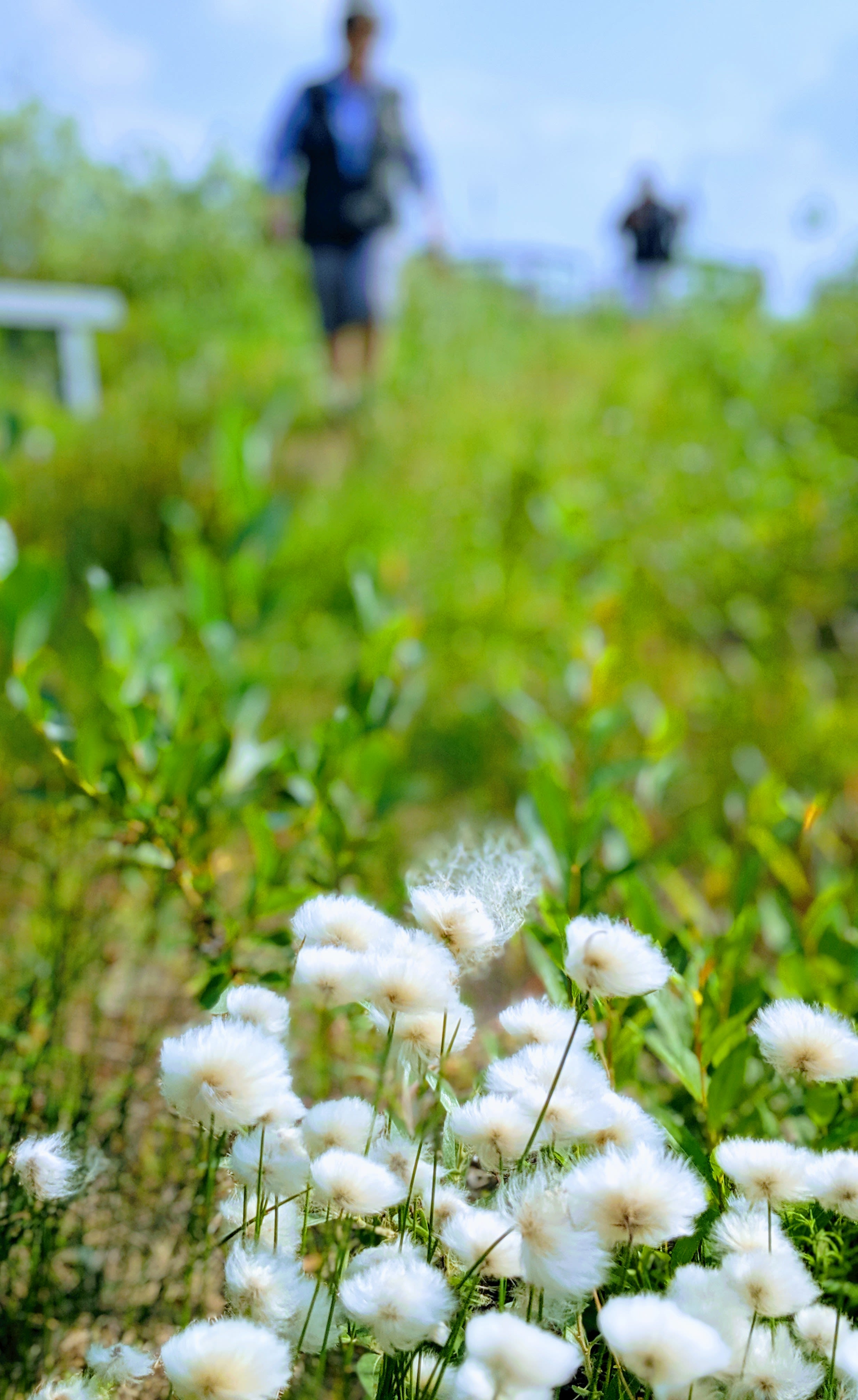
Arctic Cotton, fluffy white blooms like miniature clouds, dot the sedge wetlands. The Inuit roll the blooms in animal fat to create a flame in a qulliq. I just want to roll in the cotton.

Arctic cotton; photo by Cathy Senecal
Arctic cotton; photo by Cathy Senecal
Raw Nature Heals in the Land of the Midnight Sun
In winter, because it’s north of the Arctic Circle, the Western Arctic has temperatures well below freezing for long stretches of time, as well as 30 dark days. Summer — June through August — however, brings 56 days where the sun does not drop below the horizon.
We waterskied on the Mackenzie Delta past 11:00 pm one July night and, later, when we slipped into our tents past midnight, it was still light enough to take pictures amid a midsummer gloam. We were staying at a tent camp with an enthusiastic local who shared his thoughts on the area.
“We live here, but the North belongs to every Canadian. You’ll see dramatic landscapes with flowing waterways, pingos and frost heaves. You will be filled up by this raw, powerful place. It’s science. Raw nature heals you.”
Pingo Dabbling
I agree. I often travel to experience landscapes that are new to me — such as deserts or tropical forests — or to see unusual or natural aspects of the planet, like waterfalls or icebergs.
Pingos — ice-cored domes formed by repeated thawing and freezing — are odd, but extraordinary, landforms. Yet very few Canadians have heard of them.
Driving in just south of Tuk, I spot one — a wrinkly green tundra zit — rising above a treeless bog. On the Beaufort Sea shoreline, the Pingo Canadian Landmark features eight of the 1350 pingos on the Tuktoyaktuk Peninsula.
We paddled on the Tareoknitok Lagoon to the Parks Canada boardwalk to get a closer look at Ibyuk Pingo, the world’s second highest (the highest is in Alaska), at 49 metres high — and still growing — and 300 metres across its base.
For at least seven centuries, people here as well as their Thule ancestors used pingos — small hills in Inuvialuktun — as navigational aids as well as to spot caribou on the tundra or whales offshore.
Visit the Parks Canada website or stop in at its Inuvik office for pingo exploration options.
“We live here, but the North belongs to every Canadian. You’ll see dramatic landscapes with flowing waterways, pingos and frost heaves. You will be filled up by this raw, powerful place.
It’s science. Raw nature heals you.”
Sod It - Houses of Driftwood instead of Snow
On Tuk’s shorelines, boundless stretches of bleached driftwood, a mix of gnarled logs and tree stumps, mesmerized me.
Over the centuries, logs torn from the Liard and Mackenzie riverbanks floated with the strong current, eventually ending up in the Beaufort Sea’s sheltered bays. As Tuk was the only Arctic locale with access to this wood, residents added blocks of sod to the logs and built sod houses rather than igloos.
Today, about 900 Inuvialuit — Inuit in western Canada or Mackenzie Delta — live in Tuk in a collection of houses raised on pylons in a hamlet with a couple of gas stations and a Northern Store. But you can visit a recreated sod house to learn how people traditionally thrived in these ingenious structures.
A qulliq in a traditional sodhouse; photo by Cathy Senecal
A qulliq in a traditional sodhouse; photo by Cathy Senecal
Arctic Dips and Harpoon Throwing
I dipped a toe, but you may want to jump right in the Arctic Ocean for a swim just to say you swam in all of Canada’s oceans (presuming you’ve swum in the Atlantic and the Pacific). Snap a pic for proof, and when you’re back in Inuvik, pick up a certificate at the Visitor Centre.
I was too late for the Beluga Jamboree in April, but plan your visit then to see competitions in harpoon throwing, ice chiselling, rope wrestling and snowmobile racing.
If it is low tide, ask around to see if someone can show you the petrified caribou reefs. Long used as a fishing locale and caribou harvesting area, Tuktoyaktuk means “looks like a caribou.” Local legend says a caribou herd once waded into the ocean here and turned to stone. Reefs resembling the petrified caribou are said to be visible at low tide.
Blubber over Ocean View Rooms
Try a tiny piece of beluga muktuk, a mix of whale blubber and skin, if available, at Grandma’s Kitchen. I recommend a splash of soya sauce. Grandma Joanne often has fresh buns, burgers and chicken fingers on offer if muktuk isn’t your first choice.
Photo by Cathy Senecal
Photo by Cathy Senecal
Hunter’s B&B + the Herschel has ocean and pingo view rooms. Once the home of an Inuvialuk deacon, the Herschel is a separate renovated house moved from Herschel Island, more than 200 kilometres away. The island was the only protective harbour between the Mackenzie River Delta and Point Barrow in Alaska, offering a haven for whaling ships in the late 19th and early 20th centuries.
The campground at the end of Beaufort Road also offers ocean views. Whether you’re driving a Harley or tenting with your Subaru to Canada’s North, let the raw, powerful energy of this place wash over you.
Photo by Cathy Senecal
Photo by Cathy Senecal
Photo by Cathy Senecal
Photo by Cathy Senecal
Inside sodhouse; photo by Cathy Senecal
Inside sodhouse; photo by Cathy Senecal
Enroute to Tuk
Tuktoyaktuk is 137 km north of Inuvik, a hub of the Western Arctic at the start of the highway to Tuk. And Inuvik is at the end of the Dempster Highway, out of Yukon’s Dawson City.
Because there are only a couple of B&Bs in Tuk, Inuvik is a good place to stay before heading up the highway. Campers often leave their trailers in Inuvik before taking the occasionally rough gravel highway. Check for highway closures before travelling, and know that cell service is rare.
Inuvik; photo by Cathy Senecal
Inuvik; photo by Cathy Senecal
Photo by Cathy Senecal
Photo by Cathy Senecal
Fish tacos from Alestine's; photo by Cathy Senecal
Fish tacos from Alestine's; photo by Cathy Senecal
Igloo Church; photo by Cathy Senecal
Igloo Church; photo by Cathy Senecal
In Inuvik, visit the Western Arctic Regional Visitor Centre, tour the Igloo Church and eat fish tacos at Alestine’s, one of the very few patios north of the Arctic Circle.
For Indigenous experiences, town tours and arranging tours to Tuktoyaktuk and beyond, visit the Town of Inuvik’s site for adventure operators. Parks Canada also manages visits to Ivvavik National Park, one of the few northern parks with a comfortable base camp from which to hike the magnificent wildlife-filled terrain.
End of the Road
Writer Cathy Senecal follows the roads that lead to Canada’s far edges — places that feel remote, singular, or simply unlike anywhere else. At the end of the road, literally or not, she finds the people and moments that reveal how distinct Canada can be.
Cathy has written for The Toronto Star, explore, Travel Life and others about places and sustainable experiences including active travel, food and remote places everywhere.
End of the Road will appear seasonally.
Follow her @WildTripsAwait.