
Crafting The Table
In a former church in rural Prince Edward Island, one chef is quietly redefining what “local” really means.
By Izabela Jaroszynski

Crafting The Table
In a former church in rural Prince Edward Island, one chef is quietly redefining what “local” really means.
By Izabela Jaroszynski
“These are Colin’s tomatoes.”
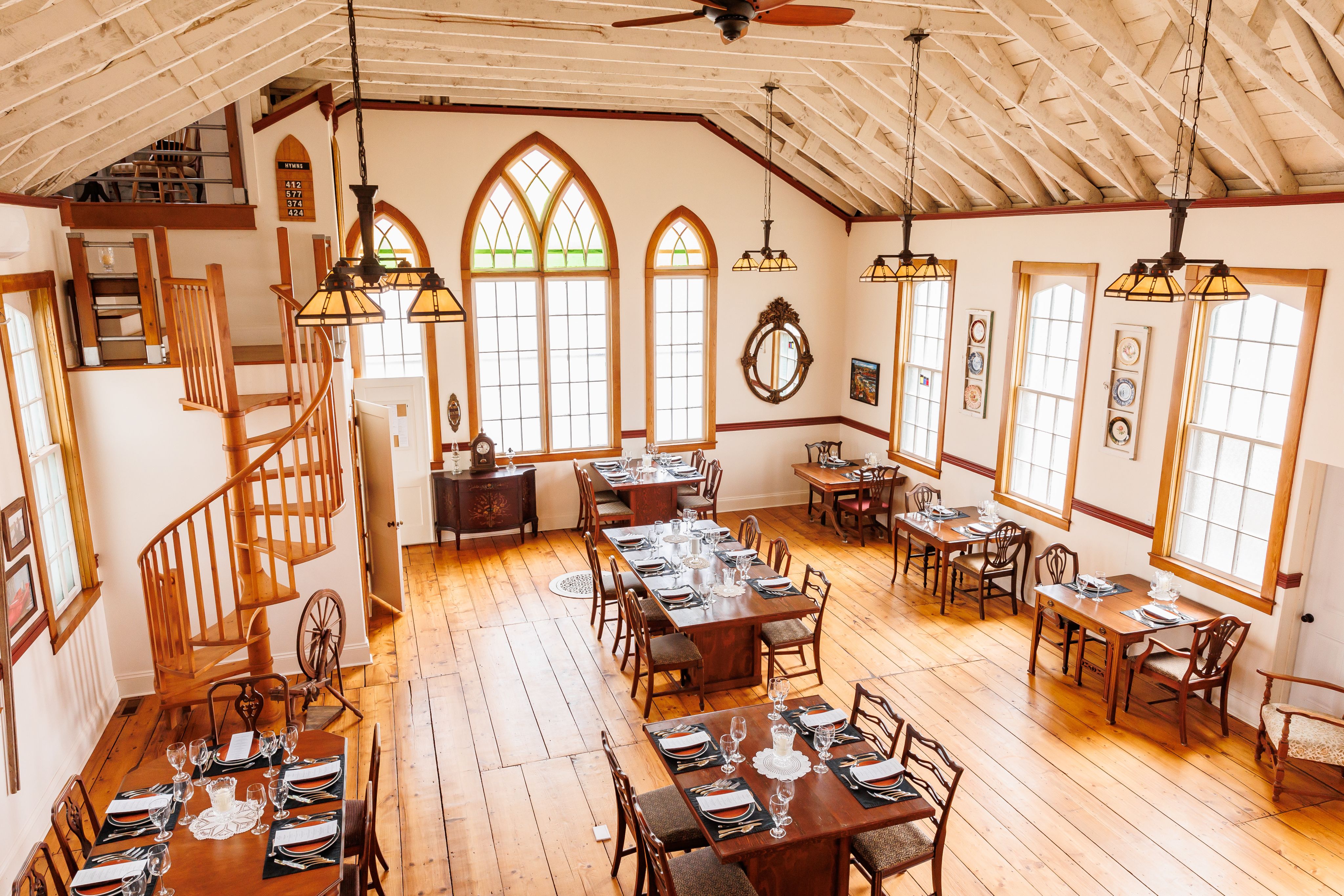
Hunter Guindon is standing in front of his guests at The Table, a restaurant in New London, Prince Edward Island. The former church is full, every table occupied, the low murmur of conversation settling as he begins to speak. Diners have booked months in advance for a seven-course tasting menu that changes week to week, committing to an experience they won’t fully understand until they sit down.
When Hunter introduces each course, he starts with the people: Colin, who grew the tomatoes. Krista, whose peppers were fermented for the dressing. Merrill, who brought in the halibut that afternoon. In this room, the food arrives threaded with names, with places, with stories.
“It’s not only the quality of the ingredients, but the relationship you have to the people that produce the food,” Hunter says.
“You can tell how much they care in the same way that I’m super proud of whatever dish I put together. Just to see them hyped up about what they grew. I'm like, ‘Oh, hell yeah. I can’t wait to go back to the restaurant tonight and tell people how excited Colin was about these tomatoes he grew.'
Food is all about that and has always been about that.”

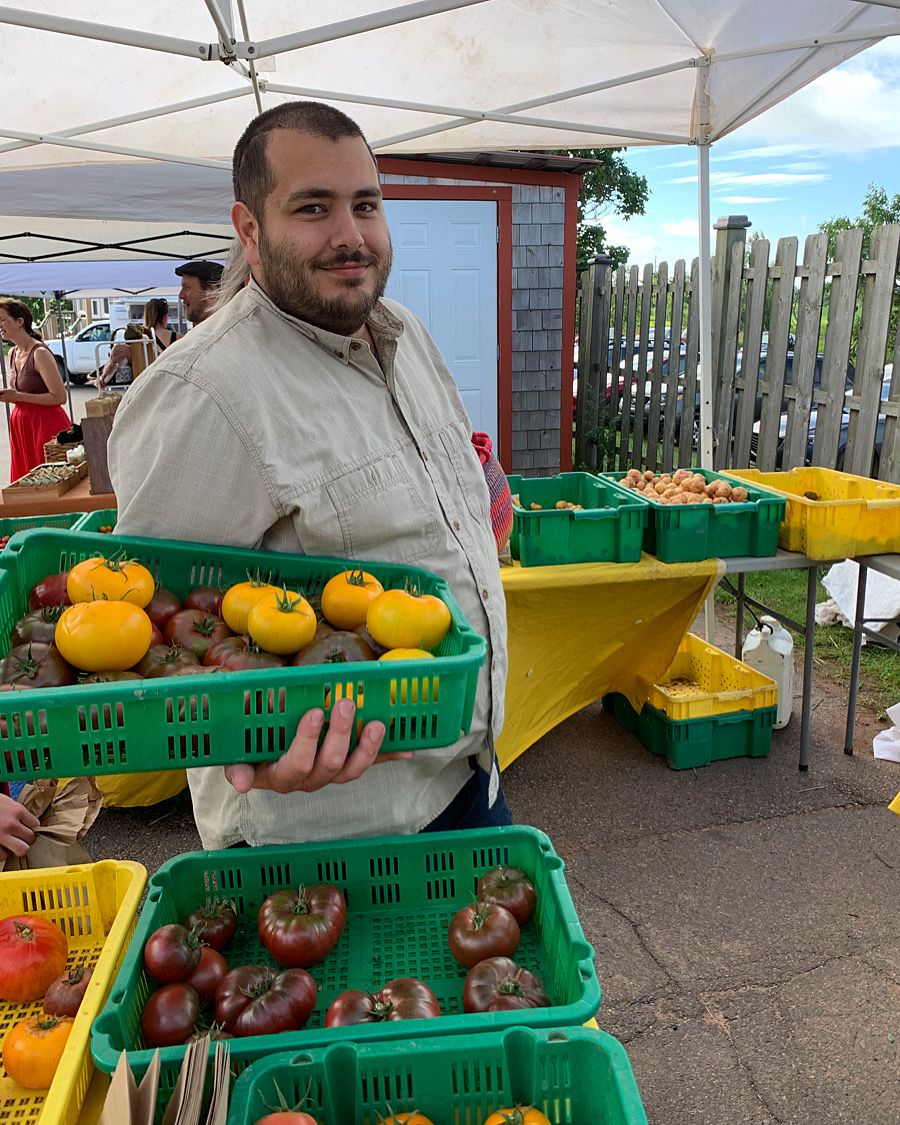


Colin’s Tomatoes from the Charlottetown Farmers Market
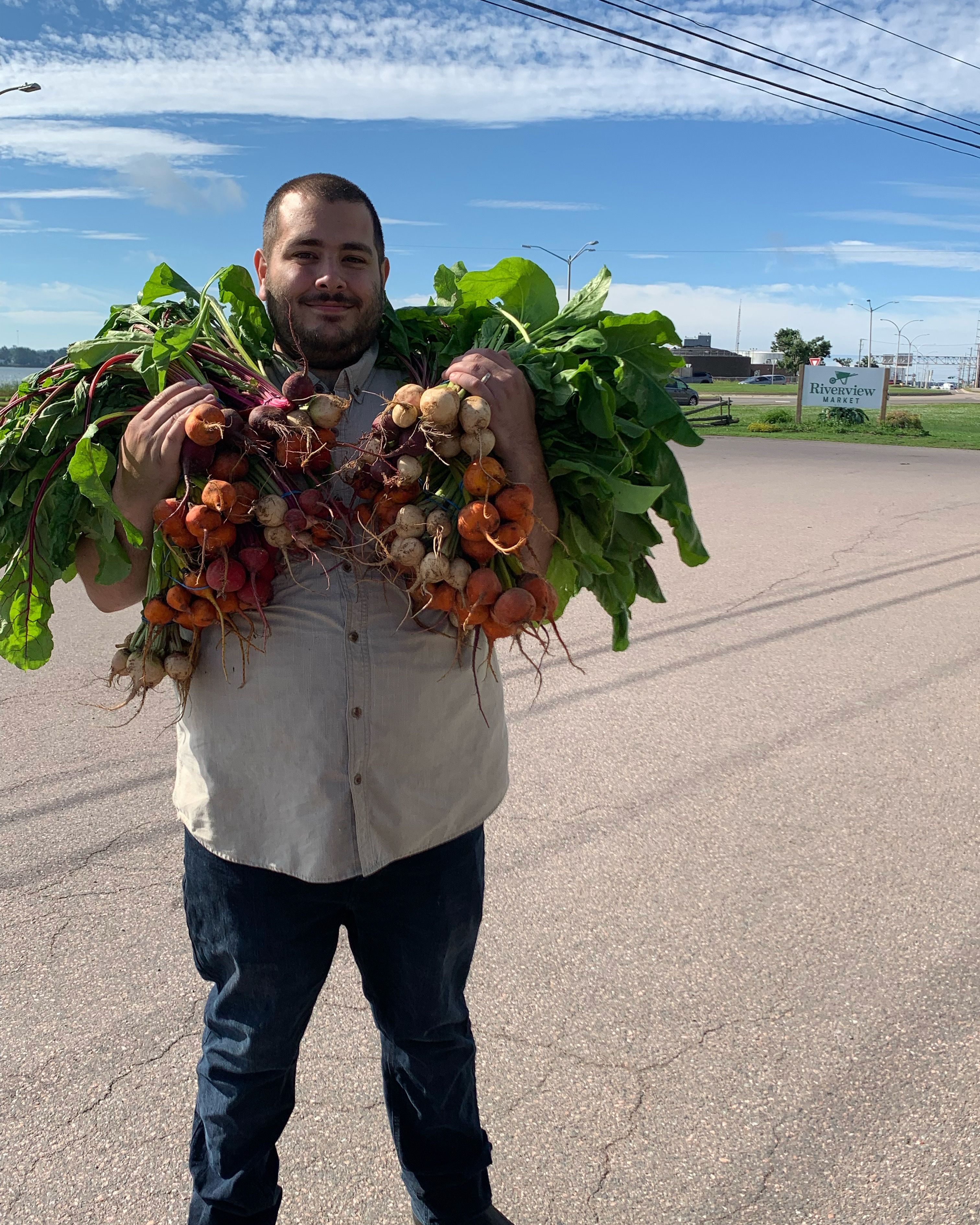
Rose & Dave’s Beets from Riverview Country Market
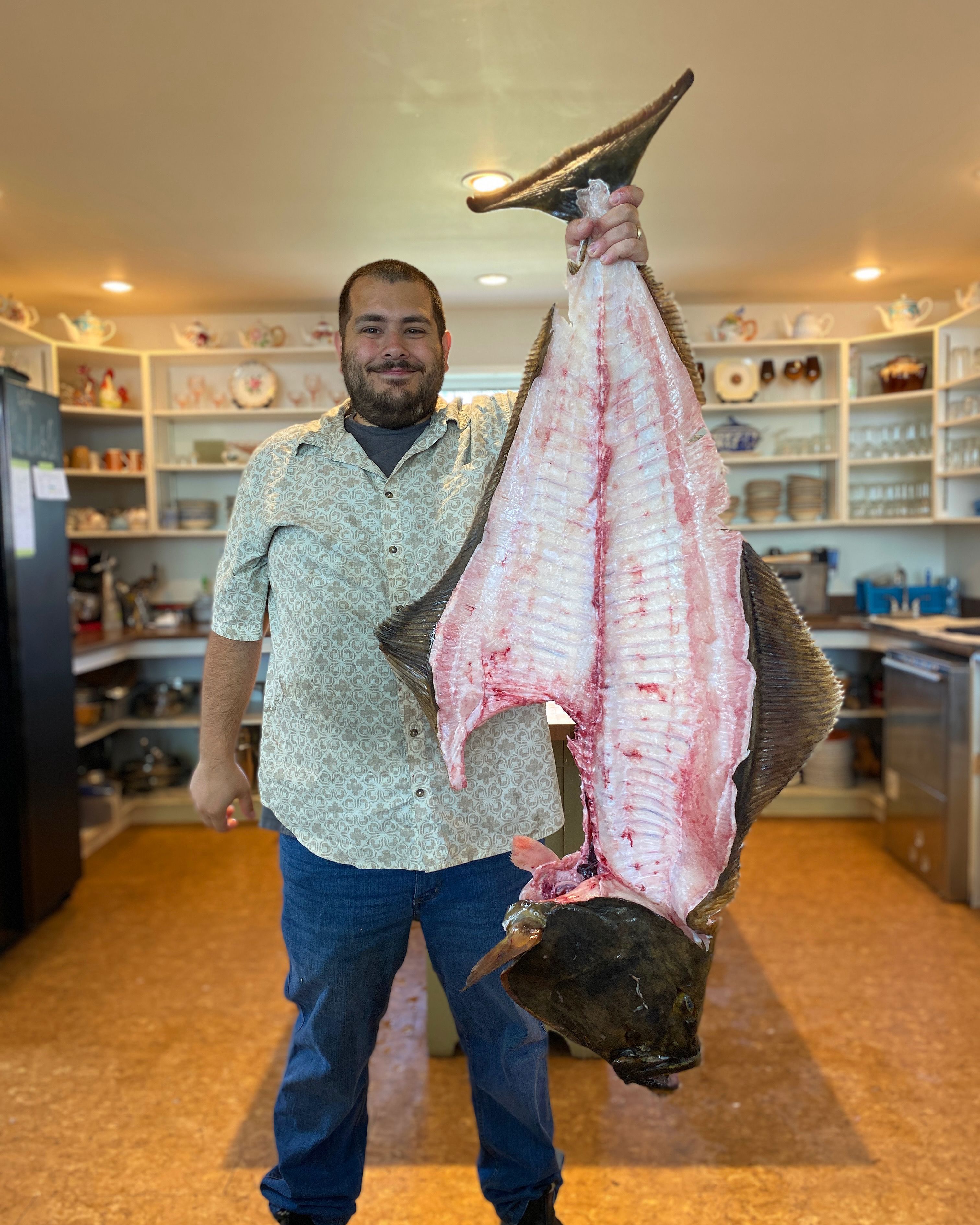
Merrill’s 96 lb halibut.
Hunter still laughs about the first time he met Merrill:
"Merrill is a halibut, lobster, and tuna fisherman from French River. He literally walked in in the middle of dinner service, came right into the kitchen and he’s like, ‘Hey man, I have this 90-lb fish. Do you want it?’ I’m like, ‘I mean, we’re on course four of seven right now, but yeah — hell yeah, bring it in, man. Let’s take it.’
And now every time he catches a halibut, as soon as he gets within cell reception on his way back in, he’ll call me and be like, ‘Hey, I have a 120-lb fish, a 60-lb fish, and an 80-lb fish. How many do you want?’ And he’ll throw them on ice in the back of his truck, and five minutes later he’s at the door, and we’re breaking it down right there.”
Hunter's relationship with food began early. Cooking appealed to him not just for the creativity, but for the way it engaged everything at once — smell, taste, sound, touch, sight — all working together in real time. At 17, he moved from Ontario to Prince Edward Island to attend culinary school and fell in love with the island.
In early 2020, just before the COVID-19 pandemic, Hunter was hired as the Executive Chef for The Table. At the time, The Table — which is located in a rural community inside a former church — served dinner family-style, with guests seated at one long communal table.
"The pandemic happened before we opened for the season, and that obviously wasn't going to fly," Hunter says. "So we decided to kind of break the table into one of many tables. People really enjoyed that, actually. It kind of brought a whole new type of clientele out to us.”

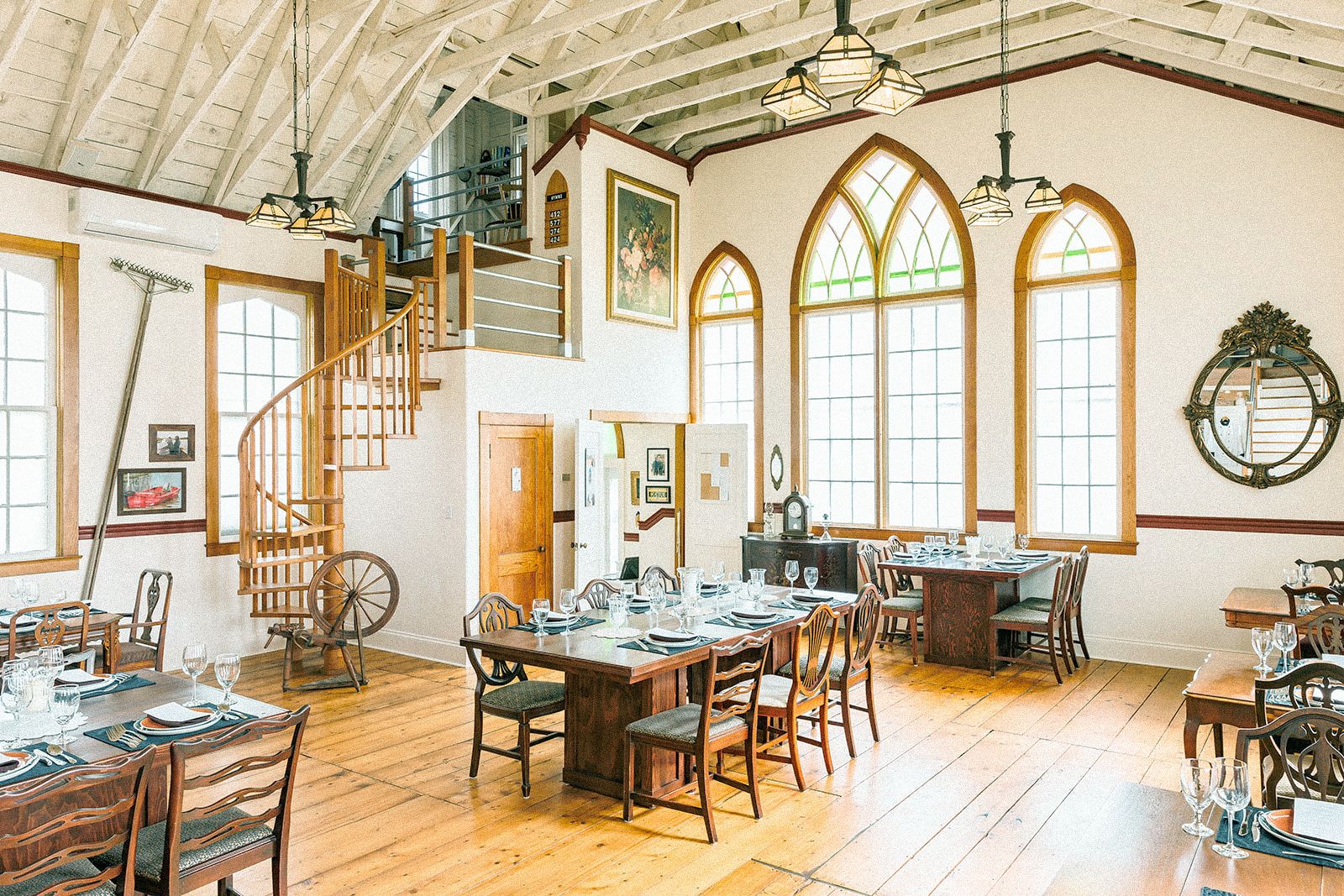
Without family-style dining, the format shifted, and Hunter was able to try something he'd been thinking about for years.
“It was kind of always a dream of mine to do a super, super hyper-local tasting menu that changed every week.”
As a young chef working in larger restaurants, he always found it disingenuous that at the bottom of their menu it said: 'We use as much local as possible.'
It bothered him — he knew what was in the fridges and it certainly wasn't very local.
“What does that even mean?” he remembers thinking. “We use as much local as is convenient for us to use; we don’t use as much as possible.”
The phrase stuck with him: How much local food was actually possible in Canada?
That question has shaped everything he has built at The Table over the past six years.
In 2026, the restaurant entered another chapter. The original owner retired and sold The Table to Hunter, who now carries it forward as both Executive Chef and owner. The philosophy he helped shape — a weekly tasting menu built entirely from Canadian ingredients — remains unchanged.
“This is literally what Canada tastes like,” Hunter says. “Every single thing you’re going to eat is grown on this land."
That means none of the typical building blocks of flavour: no lemons, no vanilla, no chocolate, no cinnamon and no black pepper.

The team builds their menu backwards. They first gather the freshest ingredients and then decide what to make with them. Sometimes someone will knock on their door with a bushel of something they've grown, and Hunter is always thrilled with the challenge of incorporating a new ingredient into his menu.
One memorable addition came from Rick.
Rick first walked into the restaurant with three peaches in his hands, casually mentioning he had “a few peach trees” at his cottage up the road in French River. Hunter told him to bring whatever he had.
For the next two weeks, Rick arrived daily with flats and flats of fruit. It turned out he didn’t have a few trees — he had 60. He had even flown a specialist in from Georgia to teach him how to plant and prune them properly. Each peach arrives wrapped individually in a paper towel, carefully nestled into beer flats. “You can just tell he gives a shit about those peaches,” Hunter says.
When it's peach season, Rick's fruit appears in multiple courses. And at the end of the season, Hunter preserves them so he has a splash of summer to add to the menu when the restaurant reopens in May.
Laid out across a butcher-block table in the kitchen, these loved ingredients become the framework for a seven-course meal that will exist for one week — and never again in quite the same way.
“We’ve changed the menu top to bottom every week. And in those six years, we’ve never repeated a dish,” he says. "Which is kind of all a part of my dream — to just constantly create new stuff. By the time I’ve cooked those seven dishes for five nights, I’m bored with them, and I don’t ever want to cook these things again. Let’s cook something new.”
What arrives on the plate is fleeting. What remains is the connection.
Below, Hunter takes us through some recent dishes at The Table — a journey across Prince Edward Island told through the hands that grew, raised, and harvested each ingredient.
Mel’s PEI Wagyu: Mel Crane, an Island veterinarian, started raising a few Wagyu cattle on the island as a bit of a passion project.
One day, I walked into our butcher’s (Mike) shop to see what we had for us that week (as we do every week) and he told me that Mel sent just one of his Wagyu animals to be butchered, and that Mike bought all of it, and set it all aside for us, knowing we’d treat it with the respect it deserved.
Darren’s Mushrooms: Darren from 2B Green Farm grows incredible gourmet mushrooms at his really cool shipping container farm that’s literally inside Summerside’s city limits.
Cow’s Creamery Blue cheese aioli: Cow’s Creamery, one of PEI’s famous creameries started making their own blue cheese a couple years ago in Charlottetown — and I’d put it up against any of the worlds best blue cheeses.
My best friend Alex, who has been my sous chef for the last four years, is also a professional potter.
Over the years, we’ve had him each year make us another set of pottery — whether it’s a bowl, a plate, the style is kind of all up to him, he's a creative guy — in the effort to completely replace all of our plateware with his handmade pottery.
It’s literally this guy who just cooked your fish, also made the plate himself that you’re eating it off of.
Souris scallop ceviche: Scallops (cured in rhubarb juice) from a scallop bed in Souris that hadn’t been fished in years.
When I showed up at my fishmonger’s (Reggie's) shop, he came from across the shop with some of these beautiful scallops he set aside for us, and was excited to tell me the story of this scallop bed, and the fellas who had started fishing it again.
Raw rhubarb: From my wife Kelsey’s home garden
Allie’s snow peas: From Ten Acre Woods Farm at the Charlottetown Farmers' market. Allie’s tent is always my first stop at the market, especially when I’m specifically looking for “cute little vegetables.”
Striped bass crudo: Raw striped bass, a native species to this area, that we get from a group of Indigenous fishers off the north shore.
Matt’s strawberries: From Matt Compton’s farm in Summerside. It’s not summer on PEI without strawberries.
Alder Pepper or Dune Pepper: The young catkins from the alder tree, which we use as “pepper” in place of black peppercorns. The window for harvest each spring is tight, so we go to our local alder patch and harvest enough for the whole season in one day, then spend the next few days dehydrating it. We store these catkins just like you would peppercorns and use them all season long anywhere that a normal restaurant would use pepper.
Dill & buttermilk vinaigrette: The dill is from Aman at A-OK Gardens, our go-to guy for herbs and vegetables at the Charlottetown Farmers Market. Aman is an immigrant from Iran who was an agriculture researcher back home, and decided to start an organic farm on PEI when he moved to Canada. The buttermilk is from our local daily co-op, ADL.
Merrill’s halibut: Our friend Merrill from French River, just one wharf over from us, knows I love island halibut, and that I want it super fresh. Anyone near the restaurant during our short halibut season is bound to see Merrill and I dragging a big ol’ halibut out of the back of his truck and into the restaurant.
Kelsey’s beans: My wife, Kelsey, grows an incredible garden at home — which means I always get first dibs on her incredible vegetables!
Dulse tapenade: Made in-house from dulse harvested off Gran Mannan Island in New Brunswick
Al’s black garlic: An ingredient that often makes an appearance on our menus from our friend Al, whose farm is literally just at the end of our road. While we use Al’s fresh garlic every day, his sweet & umami fermented black garlic has a flavour all its own, that we love to show off!
Rhubarb curd tart: Made with rhubarb from my wife Kelsey’s garden. Rhubarb is a staple in our cooking – the ingredient we use in place of any citrus fruit. Each spring, we juice a few hundred pounds of rhubarb and use the raw juice throughout the season in place of any citrus fruit.
Sweet Clover Ice Cream: Sweet clover is what we use in place of vanilla in all of our baking. A wild flower, Sweet Clover is both similar to vanilla, and unique in its own right – Canadian vanilla, if you will.
Striped bass fish sauce caramel: Our own PEI version of Salted Caramel, if you will. We made a basic caramel sauce, but “salted” it with Striped Bass fish sauce that we fermented in-house over the winter using the carcasses of the striped bass from last year.
The Table is open from mid-May to late September. Reservations are necessary and should be made as early as possible, as tables fill up quickly.
Step into the story.