

Coast To Coast
Discover Newfoundland & Labrador, Canada's Easternmost Province
A 21-day journey through outports, remote islands, and four UNESCO World Heritage Sites, shaped by geology, history, and life along the North Atlantic.
Coast to Coast
Discover Newfoundland & Labrador, Canada's Easternmost Province
A 21-day journey through outports, remote islands, and four UNESCO World Heritage Sites, shaped by geology, history, and life along the North Atlantic.
Newfoundland and Labrador is a place where distance matters — not just in kilometres, but in culture, weather, and time. This 21-day journey traces the province from its eastern edge to the Labrador coast, linking remote islands, historic fishing communities, and four UNESCO World Heritage Sites that speak to some of the deepest human and geological histories in North America.
The route balances long coastal drives with time to settle into place, pairing guided interpretation with independent exploration. Along the way, you’ll walk ancient fossil beds at Mistaken Point, trace Norse settlement at L’Anse aux Meadows, explore the geological drama of Gros Morne, and step into the whaling history of Red Bay. Time on Fogo Island, Quirpon Island, and Battle Harbour adds further perspective — places where isolation has preserved strong local identity and a close relationship with the sea.
Days 1–2: Eclectic St. John’s
Photo: Scott McClellan
Photo: Scott McClellan
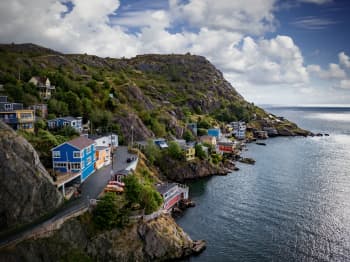
Arrive in St. John’s and settle into the historic downtown, where steep streets and a working harbour immediately establish the province’s maritime character.
Use your first afternoon to adjust to the local pace, exploring the waterfront and nearby neighbourhoods.
The following day, meet a local guide for a practical introduction to St. John’s and its surrounding headlands. Visits to key viewpoints and neighbourhoods explain how geography shaped settlement, trade, and daily life, offering essential context before travelling farther afield.
Day 3: Southern Avalon & Mistaken Point
Mistaken Point; photo: Dru Kennedy
Mistaken Point; photo: Dru Kennedy
Travel south along the Avalon Peninsula to Mistaken Point, a UNESCO World Heritage Site protecting some of the world’s oldest known complex fossils.
Mistaken Point fossils; photo:Dru Kennedy
Mistaken Point fossils; photo:Dru Kennedy
A guided visit brings you to the restricted fossil beds, where preserved ancient sea floors reveal early life forms dating back more than 560 million years. The surrounding coastal barrens illustrate how isolation, climate, and geology continue to shape both landscape and community.
Days 4–6: Trinity & the Bonavista Peninsula
Tourism Newfoundland and Labrador
Tourism Newfoundland and Labrador
Drive north to the Bonavista Peninsula and base yourself near Trinity, a region known for its preserved fishing stages, mercantile buildings, and sheltered coves.
Over several days, explore historic townsites, coastal trails, and geological viewpoints within the Discovery Global Geopark, where uplifted sediments, sea stacks, and erosion tell a long environmental story.
Destination Canada
Destination Canada
A small-group boat tour offers close viewing of whales, seabirds, and sheer coastal cliffs, while free time allows for visits to craft studios, working wharves, and quiet walking routes that reflect the peninsula’s enduring maritime culture.
Days 7–8: Fogo Island
Barrett & MacKay Photo
Barrett & MacKay Photo
Travel north and cross by ferry to Fogo Island, a place shaped by fishing traditions, Irish heritage, and community-led cultural renewal.
Settle into the island’s slower rhythm, exploring outports such as Tilting, where sod houses, shoreline stages, and Irish influences remain visible. Walk rugged coastal trails, visit artisan workshops, and spend time with residents whose lives remain closely tied to the sea and local stewardship. The island’s open rock, quiet coves, and strong sense of place reward unhurried exploration.
Days 9: Fogo to Gander
Tourism Newfoundland & Labrador
Tourism Newfoundland & Labrador
Enjoy a final morning on Fogo Island before returning by ferry to the mainland.
If conditions allow, detour toward Twillingate for classic North Atlantic views and potential iceberg sightings. Continue to Gander, a central community that serves as a practical stopping point before the longer westward drive toward Gros Morne.
Days 10–13: Gros Morne National Park
Barrett & MacKay Photo
Barrett & MacKay Photo
Cross the island westward as the landscape shifts from boreal forest to the dramatic contours of the Long Range Mountains.
Base yourself in Woody Point, a small working community within Gros Morne National Park overlooking Bonne Bay.
Tablelands; photo: Dru Kennedy
Tablelands; photo: Dru Kennedy
Over several days, explore the park’s defining features: a boat journey through Western Brook Pond’s freshwater fjord, carved by glaciers; an Indigenous-led cultural experience that shares Mi’kmaq knowledge of land, medicine, and story; and independent hikes such as the Tablelands, where exposed mantle rock reveals Earth’s inner layers, or Green Gardens, where coastal ecosystems contrast sharply with alpine terrain.
Together, these days provide a deep understanding of why Gros Morne holds global geological significance.
Days 14–15: Quirpon Island & L’Anse aux Meadows
Photo: Finn Beales
Photo: Finn Beales
Travel north to St. Anthony and continue by small boat to Quirpon Island, staying at a historic lighthouse site perched at Newfoundland’s northern tip.
Photo: Ben Heath
Photo: Ben Heath
The island’s isolation and open coastal views offer excellent land-based whale watching and, in early season, drifting icebergs carried south by the Labrador Current.
Barrett & MacKay Photo
Barrett & MacKay Photo
Zodiac touring explores nearby feeding zones, followed by a visit to L’Anse aux Meadows, the only confirmed Norse settlement in North America. Reconstructed sod buildings and archaeological interpretation reveal early trans-Atlantic contact around the year 1000.
Days 16–17: Red Bay, Labrador
Photo: Dru Kennedy
Photo: Dru Kennedy
Begin the journey into Labrador, travelling through sparse settlements and rugged coastal terrain to Red Bay.
This UNESCO World Heritage Site preserves the remains of a 16th-century Basque whaling station, including underwater archaeology that documents one of Europe’s earliest industrial enterprises in North America.
Chris Crockwell
Chris Crockwell
Interpretive centres and preserved structures explain how the whaling industry shaped the region’s coastline and global trade networks.
Days 18–19: Battle Harbour
Photo: Dru Kennedy
Photo: Dru Kennedy
Take the boat to Battle Harbour, a restored fishing station that once served as the commercial and administrative heart of Labrador’s fishery.
With minimal modern development and no vehicles, the island offers an intact historical environment. Guided walks introduce merchant buildings, salt stores, and community life, while independent time allows for quiet exploration of paths, restored structures, and coastal lookouts.
Photo: Dru Kennedy
Photo: Dru Kennedy
Conversations with staff often provide insight into sealing history, fisheries management, and ongoing preservation work.
Day 20: Head to Cornerbrook
Ferry from Battle Harbour; photo: Barrett & MacKay
Ferry from Battle Harbour; photo: Barrett & MacKay
Depart Battle Harbour and retrace the route south, crossing back to Newfoundland by ferry. The long travel day reinforces the province’s scale. Arrive in Corner Brook for an overnight rest.
Day 21: Departure
Your journey concludes today. Depart with a layered understanding of Newfoundland and Labrador — shaped by deep geological time, early human migration, maritime industry, and communities that continue to live with, and adapt to, one of North America’s most demanding coastlines.