

The Land of Giants
An out-and-back road trip along Québec's famous Whale Route in Minganie, Côte-Nord
By Andréanne Joly
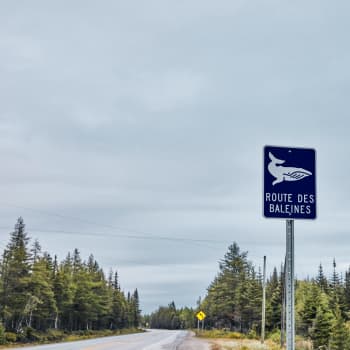
From Quebec City, Route 138 follows the St. Lawrence northeast. It traces bays, climbs mountains and skirts the shoreline as the river gradually widens into an estuary. Past Tadoussac, the 138 becomes known as the Whale Route (Route des Baleines), an 850-kilometre road that hugs the banks of the St. Lawrence all the way to the small coastal village of Kegaska, where the pavement ends.
But long before reaching the famous "End of Route 138" sign, the landscape begins to transform. East of Sept-Îles, the distances between communities grow longer, the trees grow shorter, and the gulf stretches to the horizon. This is Minganie, a vast area of Québec's Côte-Nord region where a single road connects rivers, islands and coastal villages.
In each bend of the road, the untamed grandeur of Côte-Nord reveals itself a little more.
Few people know the eastern reaches of Route 138 as intimately as Guillaume Hubermont. The Belgian-born writer spent years exploring Québec's North Shore and later chronicled the journey in Côte-Nord: visite guidée sur la route 138, a guide to the region.
He first drove the route in 2007, following a woman he'd fallen for. Travelling east from Québec City through Baie-Saint-Paul, Tadoussac, Baie-Comeau and Sept-Îles, he gradually left the familiar behind. By the time he reached Sheldrake, in the heart of Minganie, he was awe-struck.
"I felt like I had landed on another planet," he said.
“This road feels as though it was poured directly into the taiga. It follows the St. Lawrence the entire way, but even more than that, you're always right beside the water. "
River to River
It is easy to forget how recently the road arrived here, dwarfed by the scale of the Gulf of St. Lawrence and its rugged coastline.
Until 1960, Route 138 ended in Sept-Îles. It reached Havre-Saint-Pierre in 1976, Natashquan in 1996, and finally reached Kegaska in 2013.
Along its route, it crosses river after river in Innu territory.
In Minganie, the rivers are more than landmarks. They have shaped communities, sustained livelihoods and carried stories for generations.
Route 138 crosses Manto Sipo, also known as the Sheldrake River, once an important salmon-fishing post.
Farther east, it spans the sheltered harbour of U'suk Sipo, or Rivière au Tonnerre, before reaching Mutehekau Hipu, the Magpie River, whose dramatic cliffs and powerful current have earned it recognition as one of the world's most beautiful rivers - and recently even granted legal personhood.
Beyond Mutehekau Hipu, the road continues past renowned salmon rivers, including the Saint-Jean (Usasumekw) and the Aguaniche. It crosses Ekwanto, the Mingan River, once home to a significant missionary settlement, and Unamen Shipu, the Romaine River, which is now greatly diminished by hydroelectric development. Eventually, the road reaches the broad sandy bay of the Natashquan River, whose surprisingly warm waters are a well-kept secret.
Together, they form the backbone of the region.
“The water, the sea, our rivers, our beaches, that’s what draws people here," says Isabelle Richard, a proud resident of Minganie and regional tourism manager. "It’s immense and still largely untouched.”
The Road Is a State of Mind
Both Isabelle and Guillaume believe Route 138 is best experienced slowly.
There are plenty of reasons to pull over along the way. Trails branch off from the roadside, following rivers as they wind toward the gulf.
Near Rivière-Manitou, Minganie's first tourism information centre was established beside the region's namesake waterfall, where water plunges 37 metres into a rocky gorge. Two trails lead visitors to different viewpoints, offering a chance to stretch their legs and take in the landscape.
But for Isabelle, the true appeal of Minganie lies in its villages. She recommends moving east at an unhurried pace, stopping often and allowing each community to reveal its character.
Guillaume agrees. Despite the region's remoteness, a strong village culture endures here. Each community has its own beach, fish market and casse-croûte, serving as gathering places for locals and visitors alike.
Most importantly, travellers should take the time to meet the people. The ancestors of today's residents arrived from Acadia, France, Ireland, Scotland, Jersey and Newfoundland, drawn by fishing, forestry and the promise of a life on the North Shore.
There is a great deal of pride here, says Guillaume. Many residents were born before Route 138 reached their communities, and the stories of earlier generations - of isolation, perseverance and adaptation - remain part of everyday life.
Photo: Parks Canada @quebecmaritime
Photo: Parks Canada @quebecmaritime
Photo: @quebecmaritime
Photo: @quebecmaritime
Photo: @quebecmaritime
Photo: @quebecmaritime
Photo: @quebecmaritime
Photo: @quebecmaritime
The Islands
There are countless reasons to make the journey east: fishing and kayaking, Innu culture, festivals and long stretches of wild coastline.
Yet without question, the region's most iconic attraction is the protected Mingan Archipelago. Even locals return again and again to admire the roughly 40 islands, where limestone monoliths shaped by centuries of erosion rise from the gulf and Atlantic puffins nest along the shore.
Geneviève Cormier, who has worked with the Parks Canada National Park Reserve for more than a decade, is one of them.
Like many North Shore residents, she heads to the islands every summer, especially when welcoming visiting friends and family.
The magic never fails.
The landscape holds countless secrets: geological formations dating back 465 million years, metamorphic granite bedrock and hundreds of Arctic-alpine plant species.
“Without a guide explaining it to us, we would never know,” says Geneviève, who strongly encourages visitors to seek out interpretive activities with knowledgeable guides.
Local sea excursions that get visitors out on the water and to the islands.
Île aux Perroquets, home to puffins, razorbills and its iconic lighthouse, and Île Nue, known for its low vegetation and smaller monoliths, can be accessed from Longue-Pointe-de-Mingan.
From Havre-Saint-Pierre, visitors can reach Quarry Island and Niapiskau Island, where the most dramatic monoliths are found.
Quarry Island is particularly popular for hiking and camping, as are several other islands in the archipelago.
A word of caution: attempting to visit both sectors in a single day is ambitious in this land of giants.
Along the final stretch of Route 138, between Sheldrake and Kegaska, there is a sense of freedom that is increasingly rare. The road follows the Gulf of St. Lawrence, past rivers, villages and open landscapes, inviting travellers to slow down and experience the region on its own terms.
"Often, it's just you and the river," Guillaume says. "You truly feel like you're venturing somewhere beyond the ordinary.”
Singular stops on Route 138 between Sept-Îles & Kegaska
Photo: @quebecmaritime
Photo: @quebecmaritime
Ferme maricole Purmer in Sept-Îles: Join a marine farming excursion on the Gulf.
La Marinière du Nord in Rivière-au-Tonnerre: Local products and intimate meals prepared with the day's catch.
↡
Photo: Parks Canada @quebecmaritime
Photo: Parks Canada @quebecmaritime
Photo: @quebecmaritime
Photo: @quebecmaritime
↡
Photo: @quebecmaritime
Photo: @quebecmaritime
Photo: @quebecmaritime
Photo: @quebecmaritime
Andréanne Joly
Andréanne Joly has been exploring Canada’s rich and diverse Francophone communities for 25 years. She would gladly continue for another 100, as the beauty and diversity of these places never cease to amaze her. As a journalist, she regularly contributes to Northern Soul magazine, L’Express de Toronto, the tourism blog NorddelOntario.ca, and works with the Culinary Tourism Alliance. She is one of four authors of the book En train au Canada, published in 2025 by Gallimard.