

The Unblinking Wild
Searching for Grizzlies in British Columbia’s Great Bear Rainforest
By Jane Finn
The morning dawns grey and cold, yet full of promise.
Thirty of us gather beside the Tenacious 3, a small, sturdy boat operated by Campbell River Whale Watching and Adventure Tours in partnership with the Homalco First Nation, for a voyage to Bute Inlet. Raw, rugged, remote and inaccessible by road, it is a destination known to few and visited by fewer. Perched on the southern edge of the Great Bear Rainforest, it is home to a thriving grizzly bear population — the reason for today’s quest.
Every one of us is quietly willing the day to deliver.
Captain Alex and his first mate Zoe, a certified naturalist and captain in her own right, take us out of the harbour where a pair of sea lions bark farewell. Campbell River fades behind us as we push into the Salish Sea.
Open water, open sky, and the feeling that the day has not yet decided how it will unfold.
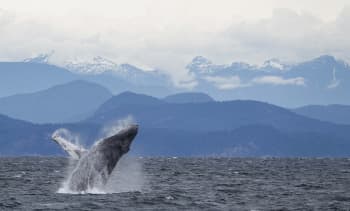
A humpback surfaces thirty metres off the port side, exhaling in a slow column of mist, and disappears. Then another surfaces, and another.
Ten minutes later, Zoe urges us to look at two o’clock, where a pod of orcas, the largest predators in the ocean, move through the water in the distance, unhurried and purposeful.
A second group surfaces as we near the mainland and stays with us until we reach shore.
To have two sightings of these elusive Killer Whales feels like a blessing, though none of us could say exactly what it promises.
As we pass Church House, a hush descends.
This was the last settlement before the remaining 500 members of the Homalco Nation relocated to Campbell River. We feel the weight of a community that once held families, language, culture and generations of traditional knowledge, abandoned when the fishing industry collapsed and took everything with it.
Zoe says the name quietly. Everyone is reverent as we pass. There is nothing left to see.
Somewhere past Church House, the water begins to change, the colour deepening from dark inky green to a shifting palette of cerulean, azure, turquoise. It is a luminous blue-green that comes only when glacial deposits meet salt water. The inlet seems to be announcing itself, intensifying with every nautical mile, drawing us forward as the fjord walls begin to rise.
We have reached the Coast Mountains, where ancient glaciers carved deep fjords into the landscape, leaving cliffs that rise almost vertically from the sea. Mount Waddington towers 4,019 metres above us, crowned by a massive glacier. The highest peak in BC, it holds both the horizon and our gaze.
The word that keeps arriving, uninvited, is primordial. This place is older than any human story told about it. Most of us feel it: small in the grand scheme of things, but part of something vast, ancient and mercifully still intact.
Bute Inlet is an 80-kilometre fjord. En route to Orford Bay, we pass cascading waterfalls and coastal peaks. The view is so beautiful that few of us notice we have quietly drifted onto shore.
Our Homalco guides meet us at the dock. James, Jared, Gary and Michael live out here in rotating shifts of two to three weeks, tending the land, managing the hatchery, monitoring the bears, the eagles, the wolves, the cougars and the salmon.
Rehabilitating the entire ecosystem is not a job, but something closer to a calling, an ancestral commitment to the seven generations that came before and the seven generations yet to come.
The moment I step off the boat, I feel completely safe. Not because danger is absent, but because the people around me are rooted here in a way that is cultural and ancestral. They know this land. The land knows them.
We leave the water’s edge and clamber aboard buses that carry us inland, past evidence of what logging took and what the land is slowly reclaiming.
Native plants crowd the roadside. Signs appear in two languages, Homalco and English, marking trails, naming places and animals, showing that not only is the forest being reclaimed, but so is a language and a way of life.
Rounding a bend, the river comes into view. A few people cheer when we spot the sign we have all been waiting for: XAWAS. Grizzly Bear.
We climb the stairs to the viewing platform overlooking the Orford River. From above, hundreds of salmon move through crystal-clear water in slow, deliberate lines, the riverbed visible in perfect detail below them. We wait. Nothing. The group begins to stir, to murmur, to gather cameras and prepare to leave.
Then Scrimmage steps out of the forest as if he has always been there.
A large male grizzly, unhurried, entirely indifferent to our presence, he wades into the river with the calm authority of an animal that has never questioned his place in the world. The group goes still. Collectively, we stop breathing. He lifts one heavy paw, pulls a salmon from the water, examines it and lets it go.
Before anyone can ask, Gary answers our unspoken question. He is not hungry, as he has been feeding for months and is ready for winter. Now he is selective and searching only for female fish full of roe.
As we descend from the platform and gather at the water’s edge, I feel a flutter of real, animal fear, and then something that completely overrides it, elation. I will be content if Scrimmage is the only bear we see all day.
But Scrimmage is only the opening act.
Stepping back from the group as others jostle for photographs, Jared quietly draws me and a woman from Sweden to one side. He tells us a story of how female grizzlies determine their capacity to support new life. Her eggs float inside her for weeks after mating, he tells us. As she moves toward winter, she asks herself first whether she can sustain herself, and then, if the answer is yes, whether she can sustain a cub. If yes, then another. The process continues until she hears a no. The remaining eggs dissolve within her to nourish the ones that remain*.
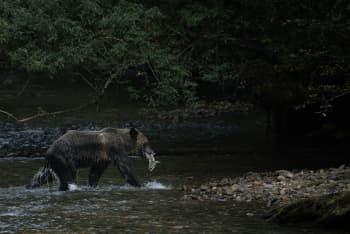
Photo: Campbell River Whale Watching and Adventure Tours
Photo: Campbell River Whale Watching and Adventure Tours
Photo: Campbell River Whale Watching and Adventure Tours
Photo: Campbell River Whale Watching and Adventure Tours
Photo: Campbell River Whale Watching and Adventure Tours
Photo: Campbell River Whale Watching and Adventure Tours
We are fortunate enough to have several more sightings that afternoon, but the most memorable comes just as we are preparing to leave.
Standing behind a stone wall watching a bald eagle return to its nest, I hear a soft splash and turn. A bear has surfaced from the river less than twenty metres away. Her eyes are dark brown, almost black. She doesn’t blink, and neither do I.
She is not threatening. She is curious, situationally aware, sensing no danger, only a desire to understand what we are doing in her world. It feels like a kind of communication, as though she is trying to impress something upon me about this place, about the work being done, so that she can live wild and free and in peace.
I don’t reach for my camera because I don’t want to break what is happening.
I think of our guides and the Homalco Peoples' quiet, unwavering commitment to restoring the river and protecting what remains of something irreplaceable. The bear is not wrong. The work is being done. The land is being held.
The journey home is its own adventure entirely.
We thread Seymour Narrows, one of the world’s fastest-moving tidal rapids, and every person on the boat grips the rail and grins. The water surges and churns with a force that feels personal, deliberate, alive. I feel like an early explorer who has stumbled into something far larger than themselves. Nature is making her power known, and it is an absolute rush.
Then, as if the sea knows we need to come back to earth, we find a colony of more than fifty Steller sea lions hauled out on the rocks. Some are shy, pressed flat against the stone, watching us sideways. Others are theatrical, preening, bellowing, launching themselves into the water with spectacular indifference to the humans who have entered their domain. A few sidle alongside the boat, curious about these visitors who have come to call.
We are heading to the marina when a lone humpback announces herself nearby. Lunge feeding, her great head and nose break the surface, then a quick dive, a flash of fluke, and she is gone. The whole boat exhales. We linger longer than we should. We are running late, but no one minds.
Then Captain Alex opens the throttle, and suddenly we are flying down Johnstone Strait, the bow lifting, sea spray coming over the rails in sheets. I am up top on the open viewing deck, completely drenched, face wet, shoulders soaked, legs giving up any pretense of dry, and I am laughing.
The water is silver, the air tastes like salt, and I feel wild, free and alive.
Author's Note: Go. Take nothing but photographs. Leave nothing but gratitude. And if a bear looks you in the eye and doesn’t blink, don’t blink either. Stay present. Let it mean something.
My thanks to Captain Alex and Zoe, to James, Jared, Gary and Michael of the Homalco Nation, and to the 31 other souls aboard the Tenacious 3 for one of the most extraordinary days of my life.
*A note on the cultural teaching: The story shared by Jared about the female grizzly’s capacity belongs to the Homalco First Nation. It is included here with the spirit of gratitude in which it was offered, and readers are encouraged to seek out Homalco-led experiences to hear such teachings directly from those who hold them.
Jane Finn
Jane Finn is a freelance writer with a passion for storytelling. She writes to capture the spirit of the land and the people who live there. Her stories inspire readers to be curious, open-minded, and open-hearted when they travel and do more than visit the guidebook sites or the number one-rated restaurant in any destination.
Jane’s travels and her perspective on life have been enriched by the people she has met along the way. Through her writing, Jane aims to connect community, culture and conservation.