

Walking Through History
Exploring the Japanese Canadian Legacy Trail and the history of internment in British Columbia’s Slocan Valley
By Claudia Laroye
In a small yellow clapboard building behind the Steveston Museum & Post Office in Richmond, British Columbia, a large black and white photograph silently narrates a moment in time of a cold December day nearly 85 years ago.
I quickly lose count of the number of fishing boats tied up together on the shoreline of the Fraser River. The grainy picture on the wall of the newly named Steveston Japanese Canadian Museum depicts a fraction of the 1,200 marine craft that were impounded along B.C.’s coast the day after Pearl Harbour and Canada’s declaration of war on Japan in 1941.
Photo by Claudia Laroye
Photo by Claudia Laroye
Steveston’s historic waterfront was once part of a thriving fishing community, known as Sutebusuton to the more than 2,000 Japanese Canadians who called the community home since the first wave of immigration in the 1800s.
The vessels’ impoundment was the first step in the Canadian government’s swift efforts to detain “enemy aliens” whose homes, boats and businesses were confiscated before restricting, detaining and interning more than 22,000 Japanese Canadians, most of whom were citizens by birth or naturalization.
The great uprooting and internment of Nikkei (people of Japanese descent living abroad) in remote work camps and ghost towns far away from coastal British Columbia, and their further displacement eastward after the end of the war, represents a difficult period of Canadian history that few remember or have even heard about.
A new self-guided journey in the scenic Slocan Valley in B.C.’s West Kootenay region aims to change that, inviting travellers to explore the cultural and historical legacy of Canada’s tumultuous World War II period.
The Japanese Canadian Legacy Trail is a 60-kilometre route from Slocan to Sandon (it will eventually touch on other locations throughout the province), connecting museums, memorial gardens and historic sites. The trail honours the legacy of internees and offers opportunities for present-day Canadians and tourists to travel with intention and experience the past while walking in the present.
Amid the Slocan Valley’s towering mountain peaks and tranquil lakes, travellers come face to face with the challenging accounts of injustice, resilience and community spirit in former internment camp sites.
The Trail represents a chance to learn and confront with an uncomfortable, even unknown history, one with important lessons for contemporary times.
The heart of the Trail is the Nikkei Internment Memorial Centre, a National Historic Site located in New Denver. This small community on the shores of Slocan Lake was chosen as the location for one of the largest internment sites, established in 1942 on a former fruit grove.
The Orchard was the first Japanese Canadian internment camp in the Slocan Valley, housing nearly 1,600 people in 275 tar-paper shacks.
The Centre’s photographic exhibitions detail how families were first detained and processed in Hastings Park in East Vancouver and then moved by rail slowly inland, away from their homes in Steveston, Vancouver and other coastal towns to resettlement camps in the Orchard and other Slocan Valley internment sites like Slocan City, Lemon Creek and Popoff Farm.
The situation and conditions they encountered were shockingly different from the lives they’d once known.
The haste of internment meant that arriving families were often housed in makeshift canvas tents as wooden shacks were constructed as fast as possible. The shacks housed two families each, who were crowded into cramped, uninsulated structures measuring 14’ x 28’, less than 400 sq feet.
Neil Dunnigan, photo by Claudia Laroye
Neil Dunnigan, photo by Claudia Laroye
Neil Dunnigan, an interpretive guide at the Centre, describes how, during the bitter cold of the winter of 1942-43, internees would wake up frozen to the walls, scraping ice off the ceiling before lighting stoves to avoid tuberculosis conditions.
“Many Canadians do not have knowledge or understanding of this dark chapter in Canadian history,” Neil tells me as we walk between the Centre’s two preserved board and batten shacks.
Built by internees more than 80 years ago, the furnished interior displays authentic objects of daily life, such as cooking pots, sewing patterns, and simple furniture. My eyes are drawn to the bright yellow floral mac tac on a kitchen counter. The cheerful pattern stands in sober contrast to the torn, beige tar paper walls.
In the Centre’s Centennial Hall, stark black and white photographs are interspersed by a canvas tent, displays of cooking pots, fishing equipment, suitcases and toy dolls from the forcibly displaced internees.
They form poignant tableaux of internment life. The pictures of detention facilities, schools and baseball teams bear silent witness to an existence uprooted and confined, while reproductions of wartime public notices expose the fear and blanket racism of the Canadian and British Columbia governments of the day.
Exhibiting and sharing the history of Japanese Canadian internment is not an exercise in blame. Rather, the Trail and Centre aim to advance an understanding of this history and of the fragile nature of democracy; to illuminate the strength, recovery and resiliency of a community.
One that, despite its darkest time, organized internment lives around education and social cohesion, building schools and Buddhist temples, forming baseball teams and holding dance performances and kendo and judo competitions.
Many Slocan Valley camps, including the Orchard, remained in operation until 1946, when internees were once again displaced, pressured either to move and resettle east of the Rockies or “repatriate” to Japan. By 1951, only 250 Japanese Canadian families had returned to settle in Steveston to rebuild their lives on the coast.
Today, visitors can walk the neat and quiet streets of New Denver, keeping a sharp eye for some of the original buildings and features of the Orchard. Fewer than a dozen of these properties remain in the hands of descendants of Japanese Canadian internees. Visitors may be drawn to the quiet refuge of the Kohan Reflection Garden, another stop along the Legacy Trail.
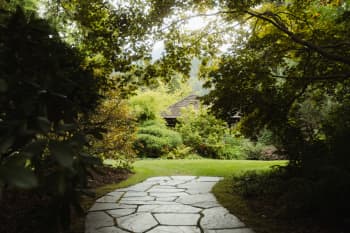
Opened in 1992 on the edge of Slocan Lake, the free strolling garden includes natural elements like maples, bamboo groves and cherry trees integrated with the distinctive architecture of bridges, lanterns and a ceremonial bell.
The Garden is a sanctuary from the outside world; a chance to reflect on the legacy and lessons of the past to ensure this inglorious chapter of Canadian history is never repeated.
Claudia Laroye
Claudia Laroye is an award-winning freelance writer and author living in Vancouver, Canada. She writes about adventure and sustainable travel for a variety of online and print outlets around the world, including; AFAR, Globe and Mail, Canadian Geographic, Toronto Star, Vancouver Sun, Saturday Evening Post, Explore and Northern Soul magazines. Her award-winning travel anthology, ‘A Gelato a Day’ was published in fall 2022.